
This guide explains how to play poker using the rules of Texas Hold'em. You get two hole cards, five community cards go on the table, and you make the best five-card hand you can. Below, we walk through one hand from the deal to the showdown and explain the blinds, the betting, and how the winner is decided.
At a glance: how to play poker
Here are the Texas Hold'em rules in six points:
- Each player gets two hole cards, and only that player sees them.
- Five community cards go face up on the table: three on the flop, one on the turn, and one on the river.
- A hand has four betting rounds: preflop, flop, turn, and river.
- On your turn, you can fold, check, call, bet, or raise.
- You make the best five-card hand from your seven cards.
- At the showdown, the best hand wins the pot. If everyone else folds, the last player left wins it.
What you need to play
Texas Hold'em uses a standard 52-card deck with no jokers. A table usually has 2 to 10 players. Every player gets two hole cards face down, and the other players cannot see them.
The pot is the money (or chips) that players bet, collected in the middle of the table. You win it in one of two ways: you hold the best hand at the showdown, or you are the last player left after everyone else folds.
The dealer button and the blinds
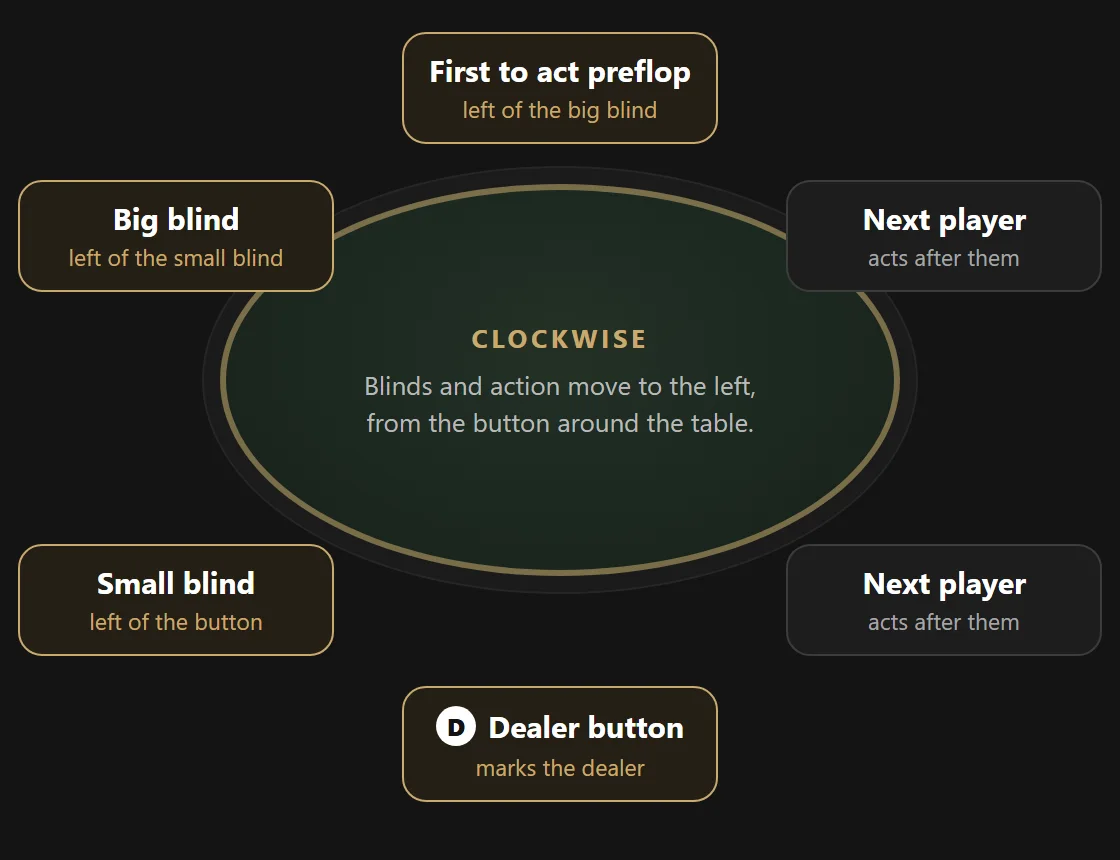
A dealer button marks the dealer's seat. The player to the left of the button posts the small blind, and the player to the left of the small blind posts the big blind. Both are forced bets.
The small blind is usually half the big blind. In a $1/$2 game, the small blind is $1 and the big blind is $2. The blinds are posted before anyone looks at their cards, and they get the action going.
After every hand, the button moves one seat clockwise (to the left), and the blinds move with it.
How a hand of Texas Hold'em works, step by step
A hand has four betting rounds. The table below shows what happens in each one.
| Round | What happens |
|---|---|
| Preflop | Each player gets two hole cards. The first betting round starts. |
| Flop | Three community cards go face up on the table. |
| Turn | A fourth community card is added. |
| River | The fifth and last community card is added. |
Preflop
Each player gets two hole cards from the dealer. The first betting round starts with the player to the left of the big blind, who can fold, call, or raise.
Flop
First, the dealer sets aside one card, called a burn card. Then three community cards go face up on the table. A new betting round follows. It starts with the first active player to the left of the button. An active player is someone who is still in the hand.
Turn
The dealer burns another card and adds a fourth community card. Betting starts again with the first active player to the left of the button.
River
After one more burn card, the dealer adds the fifth and last community card. This is the final betting round.
Showdown
If more than one player is still in the hand after the river betting, the players show their hole cards. This is the showdown, and the best five-card hand wins the pot.
The last player to bet or raise in the final round shows first. If nobody bet in that round, the first player still in the hand to the left of the button shows first. If everyone else folds, the last player left wins the pot without showing their cards.
What can you do on your turn?
When it is your turn, you have five options:
- Fold: throw away your cards and give up any claim to the pot.
- Check: pass without betting and stay in the hand. You can check only when no one has bet in the current round.
- Call: match the current bet.
- Bet: put in the first bet of a round.
- Raise: match the current bet and then increase it.
A player can also go all-in, which means betting all of their chips.
Before the flop, the blinds count as bets. That means you cannot check: you can fold, call, or raise. The one exception is the big blind. If nobody has raised, the big blind can check or raise.
A betting round ends when every player still in the hand has matched the last bet or raise, folded, or gone all-in.
Here is what a betting round can look like before the flop in a $1/$2 game. The player to the left of the big blind calls $2. The next player raises to $6. Everyone after that must call $6, raise again, or fold. The round ends when everyone still in the hand has matched the $6 or folded.
Who wins the pot?
You make your hand from the best five of your seven cards, which are your two hole cards and the five community cards. You can use both hole cards, one of them, or none.
If the best five-card hand is the five community cards, every player still in the hand uses it, and the pot is split. Suits are not ranked in Hold'em, so two hands that differ only by suit are equal and split the pot.
When two players have the same kind of hand, the higher ranks decide. If their main combinations are equal, a kicker can break the tie. A kicker is a card that is not part of your main combination, and it matters for one pair, two pair, three of a kind, and four of a kind.
Poker hand rankings
Poker hands rank from the royal flush at the top to high card at the bottom. The table lists all ten, strongest first.
| Rank | Hand | What it is |
|---|---|---|
| 1 | Royal flush | ace, king, queen, jack, and ten of the same suit |
| 2 | Straight flush | five consecutive cards of the same suit |
| 3 | Four of a kind | four cards of the same rank |
| 4 | Full house | three of a kind plus a pair |
| 5 | Flush | five cards of one suit, not in sequence |
| 6 | Straight | five consecutive cards, not all of one suit |
| 7 | Three of a kind | three cards of the same rank |
| 8 | Two pair | two cards of one rank and two cards of another rank |
| 9 | One pair | two cards of the same rank |
| 10 | High card | none of the above, so the highest card counts |
The ace can be low or high in a straight, but not both at once. For tie-breaks, examples, and the odds of each hand, see our poker hand rankings cheat sheet.
A hand from start to finish: a worked example
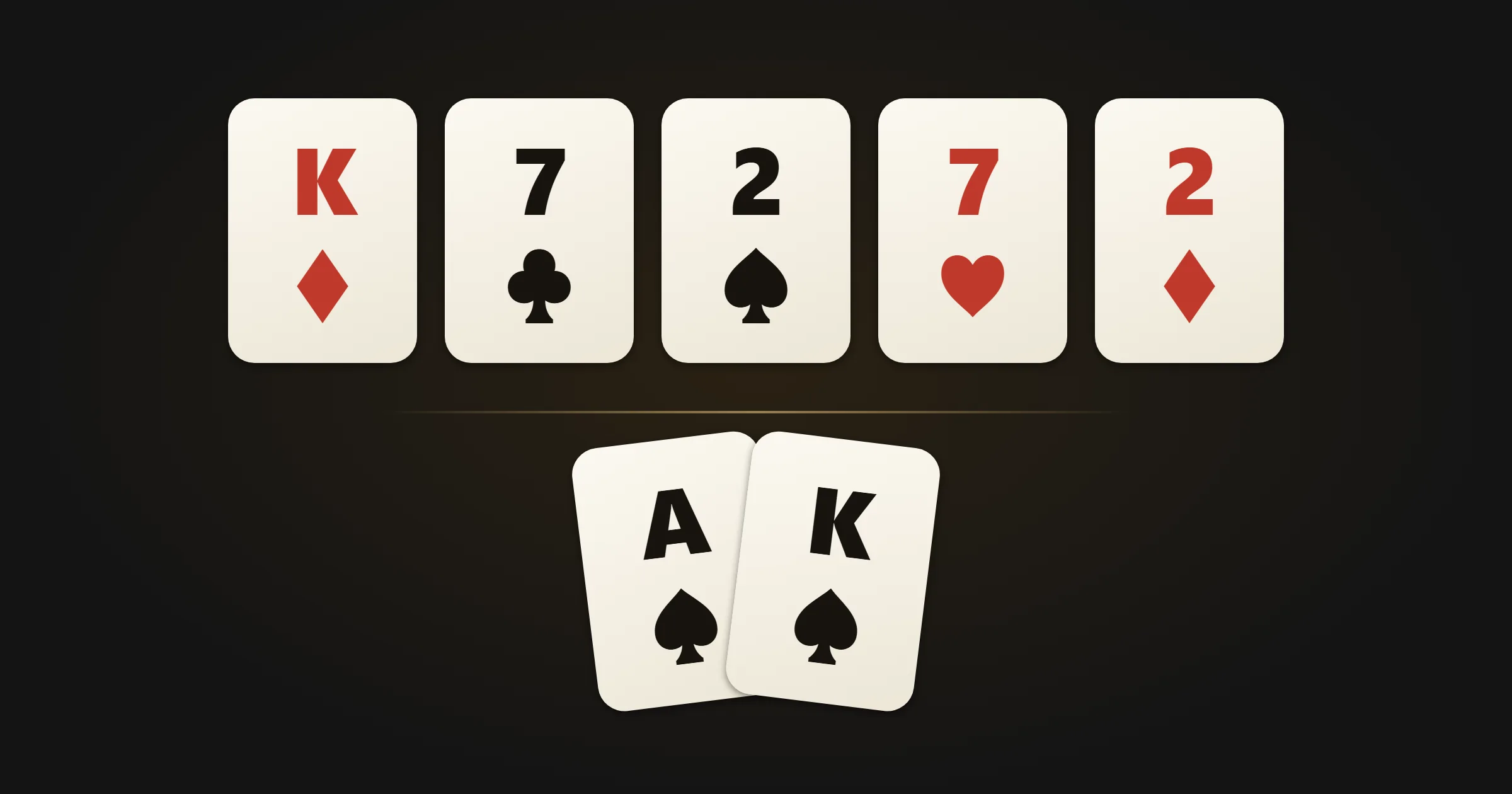
Say your hole cards are A♠ K♠. Here is how the hand develops.
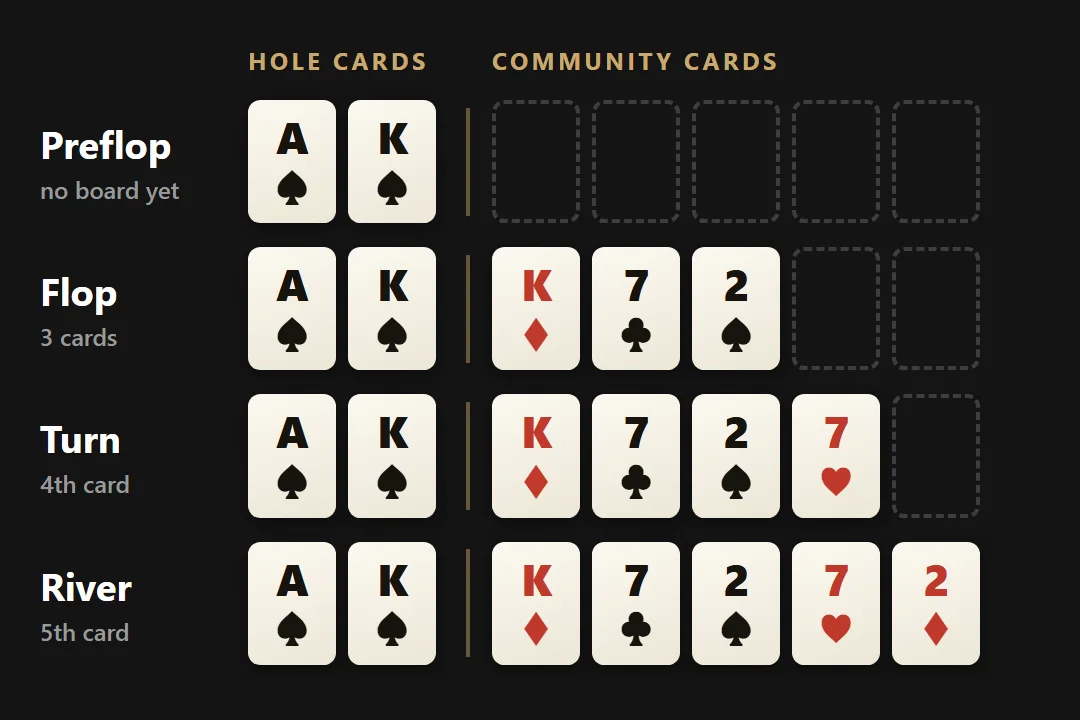
- Flop: K♦ 7♣ 2♠. You have a pair of kings.
- Turn: 7♥. Now you have two pair, kings and sevens.
- River: 2♦. The seven cards contain three pairs (kings, sevens, and twos), but you can use only five cards. Your best five are K-K-7-7 with the ace as the kicker, making two pair.
At the showdown, Ben, the only other player left, shows Q♥ Q♦. His best five cards are Q-Q-7-7 and the king, also two pair. Both of you have two pair, so the higher pair decides. Kings beat queens, and you win the pot.
Limit, pot-limit, and no-limit
The same game can be played with different betting structures.
- Fixed-limit: the bet sizes are set.
- Pot-limit: the biggest bet or raise you can make is the size of the pot, counting any bet you must call first.
- No-limit: you can bet any amount, up to all of your chips.
Playing with two players or at home
In a game with only two players, called heads-up play, the player on the button posts the small blind and the other player posts the big blind.
Casinos and poker rooms use a professional dealer. At home, the player with the button usually deals. The same poker rules apply either way.
Before your first game: a short checklist
Run through this list when you sit down at a table:
- Find the dealer button and see who posts the blinds.
- Look at your two hole cards.
- Keep the hand rankings table close until you know the order.
- Remember that the action moves clockwise, to the left.
- Wait for your turn, then choose to fold, check, call, bet, or raise.
Common beginner mistakes
Most beginner errors come from five misunderstandings.
- Thinking you must use both hole cards. You can use two, one, or none of them.
- Ranking suits. In Hold'em, all suits are equal.
- Checking when there is a bet. You can check only when no one has bet in the round.
- Forgetting that blinds are bets. Before the flop, the blinds count as bets.
- Ignoring the kicker. When two hands match, the kicker can decide the winner.
Test yourself
How many community cards are dealt in total? Five: three on the flop, one on the turn, and one on the river.
Can you check after the player before you bets? No. You can check only when no one has bet in the round.
Which is stronger: a flush or a straight? A flush.
Poker rules FAQ
How do you explain poker in simple terms? Each player gets two hole cards, five community cards go on the table, and everyone tries to make the best five-card hand. You win the pot by having the best hand at the showdown or by being the last player left.
Is poker all luck? No. A single hand involves a lot of chance, but players' decisions shape their results over the long run.
How many players can sit at a Texas Hold'em table? Usually 2 to 10.
How many cards does each player get? Two hole cards.
How many cards does the dealer burn? Three: one before the flop, one before the turn, and one before the river.
What happens if two players have exactly the same hand? The pot is split.
New to the words used here? Our poker terms glossary explains them in one place.
Responsible gambling
Poker played for money is gambling. Only play with money you can afford to lose. Real-money online poker is legal only in some US states. It is regulated state by state, and the minimum gambling age is 21+ in many states and 18+ in others, depending on the state and the product. Check your state's gaming regulator before you play for money, and play only on sites licensed in your state.
If gambling stops being fun, call or text 1-800-MY-RESET (1-800-697-3738) or visit 1800myreset.org. The National Problem Gambling Helpline is free, confidential, and available 24/7. It provides support and referrals to local resources. In an emergency, call 911 or 988.
More guides are on the Blog page.