
This poker glossary explains the words you hear at a Texas Hold'em table, in plain English. The poker terms are grouped by topic, so you can read them in order or jump to the group you need. For the rules behind them, see our guide on how to play poker.
Every definition here is short on purpose. Where a term has a longer story, such as hand rankings, the entry points you to a full guide.
At a glance: the poker terms to learn first
Learn these ten poker terms first, and most of a Texas Hold'em game will make sense:
- Hole cards: your two cards, dealt face down.
- Community cards: the five cards that go face up on the table.
- Flop, turn, river: the three stages in which the community cards arrive.
- Blinds: the two forced bets posted before the action starts.
- Dealer button: the marker for the dealer's seat.
- Pot: the money in the middle of the table.
- Fold, check, call, raise: your main choices on your turn.
- Showdown: the moment the remaining players show their hands.
- Kicker: a card that is not part of your main combination. It breaks a tie between otherwise equal hands.
- Hand rankings: the order of the poker hands.
Cards and the table
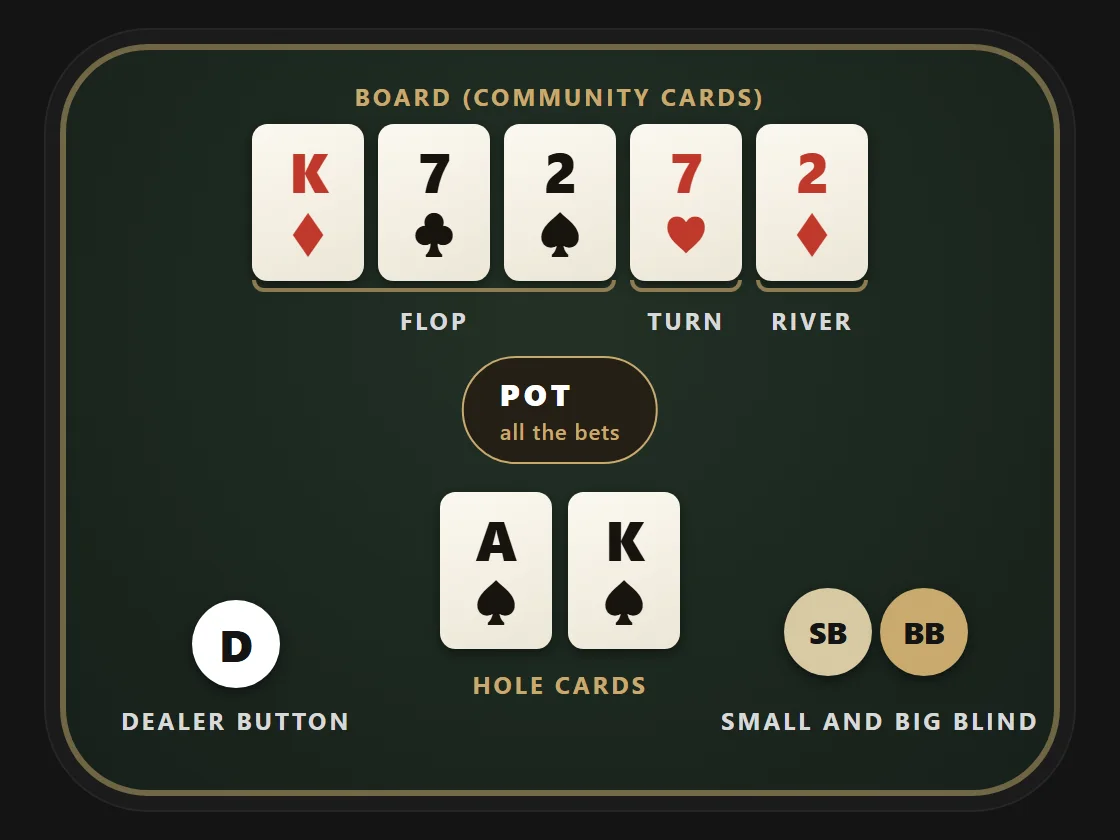
- Hole cards: the two cards dealt face down to you, which the other players cannot see.
- Community cards: the five cards dealt face up in the middle of the table. Together they are called the board.
- Flop: the first three community cards.
- Turn: the fourth community card.
- River: the fifth and last community card.
- Street: another word for a betting round, or for the card dealt for it. The turn is also called fourth street, and the river is fifth street.
- Burn card: a card the dealer sets aside face down before the flop, the turn, and the river.
- Dealer button: the marker for the dealer's seat. It moves one seat clockwise after each hand.
- Small blind and big blind: forced bets posted by the two players to the left of the button, the small blind first. The small blind is usually half the big blind. With only two players, the rule changes: see heads-up below.
- Live blind: a blind that counts as a bet and gives the player the option to raise if the action comes back unraised. The big blind is a live blind, so if nobody has raised, the big blind can check or raise.
- Ante: a forced bet that some games require from every player before the hand begins.
- Pot: the money (or chips) that players bet, collected in the middle of the table.
- Showdown: the moment after the last betting round when the players still in the hand show their cards to decide the winner.
- Split pot: the pot is divided equally when two or more players have exactly equal hands.
- Playing the board: using the five community cards as your best hand. At best, you can split the pot.
- Kicker: a card that is not part of your main combination. It breaks a tie between otherwise equal hands.
Betting actions
When it is your turn, you can fold, check, call, bet, or raise. The table shows when each one is possible.
| Action | When you can do it | What it means |
|---|---|---|
| Fold | any time it is your turn | give up your hand and any claim to the pot |
| Check | only if no one has bet in the round | pass without betting and stay in the hand |
| Bet | when no one has bet yet | make the first wager of the round |
| Call | when there is a bet | match the current bet |
| Raise | when there is a bet | match the current bet and increase it |
Before the flop, the blinds count as bets, so you cannot check unless you are the big blind and nobody has raised.
A few more betting terms come up often:
- Re-raise: a raise after another player has already raised in the same betting round.
- Check-raise: checking first, then raising after an opponent bets in the same round.
- All-in: committing all of your remaining chips, whether by betting, calling, or raising.
- Side pot: a separate pot created when a player is all-in for less than the others bet. Only eligible players can win it.
- Limp: to enter the pot before the flop by calling the big blind instead of raising.
- Muck: to discard your hand without showing it.
Seats and positions
- Under the gun: the seat to the left of the big blind. This player acts first before the flop.
- Position: where you sit in the betting order compared with the other players.
- In position: acting after your opponent, so you act last against that opponent.
- Cutoff: the seat immediately to the right of the dealer button.
- Heads-up: playing against a single opponent. In a game with only two players, the player on the button posts the small blind.
Starting hands and hand terms
- Pocket pair: two hole cards of the same rank, such as two sevens.
- Suited: two cards of the same suit. Offsuit cards are not of the same suit.
- Connectors: two cards of consecutive rank, such as 7-8 or J-Q.
- Wheel: the A-2-3-4-5 straight, the lowest straight, where the ace plays low.
- The nuts: the best possible hand in the current situation.
- Outs: the unseen cards that can improve your hand to a likely winner.
- Flush draw: four cards of one suit that need one more card of that suit to make a flush.
- Hand rankings: the order of poker hands, from the royal flush at the top to high card at the bottom. Our poker hand rankings cheat sheet lists all ten with examples.
The ten hand names
These are the names of the ten poker hands, from strongest to weakest.
| Hand | What it is |
|---|---|
| Royal flush | ace, king, queen, jack, and ten of the same suit |
| Straight flush | five consecutive cards of the same suit |
| Four of a kind | four cards of the same rank |
| Full house | three of a kind plus a pair |
| Flush | five cards of one suit, not in sequence |
| Straight | five consecutive cards, not all of one suit |
| Three of a kind | three cards of the same rank |
| Two pair | two cards of one rank and two cards of another rank |
| One pair | two cards of the same rank |
| High card | none of the above, so the highest card counts |
Strategy and mindset words
- Bluff: a bet or raise with a hand that is unlikely to be the best, meant to make better hands fold.
- Value bet: a bet made by a player who wants it to be called by weaker hands.
- Tell: a detectable change in a player's behavior, such as a gesture or a pause, that may give away information about their hand.
- Tilt: an emotional state, such as frustration or anger, that leads a player to make poor decisions.
- Bankroll: the money you set aside for playing poker.
- Stack: the total chips you have in play at the table.
Games, tournaments, and money
- Cash game: a game where each hand is played for real money, as opposed to tournament play.
- Tournament: a competition where every player starts with tournament chips, the blinds rise over time, and the winner is the player who ends up with all the chips. The chips cannot be cashed out.
- Buy-in: the amount you pay to enter a tournament, or the money you exchange for chips to sit at a cash game table.
- Freeroll: a tournament with no buy-in.
- Sit and go: a tournament that starts as soon as enough players have signed up.
- Rake: the commission a cardroom takes from a cash game pot, usually a percentage of the pot up to a set maximum. In tournaments it is collected as an entry fee.
- Fixed-limit, pot-limit, and no-limit: the three betting structures. In fixed-limit the bet sizes are set. In pot-limit the biggest bet or raise is the size of the pot, counting any bet you must call first. In no-limit you can bet any amount, up to all of your chips.
Poker terms in action: an example hand in plain English
Here is a short example hand using the terms above. In a no-limit $1/$2 game, Ben posts the small blind and Cara posts the big blind. Dan sits under the gun and calls $2, which is a limp.
Ann is on the button and raises to $6. Ben folds, and Cara and Dan call. Three players are left, and the pot holds $19: Ben's $1 small blind plus $6 from each of the other three.
Then the dealer burns a card and turns up the flop. Cara and Dan check, and Ann bets $10. Cara folds, and Dan calls. Because Ann is on the button, she is in position: she acts last on the flop, the turn, and the river.
Poker terms FAQ
What are the most important poker terms for beginners? Hole cards, community cards, the flop, the turn, the river, the blinds, the pot, fold, check, call, raise, and showdown.
What do flop, turn, and river mean? They are the three stages in which the five community cards arrive: three cards on the flop, one on the turn, and one on the river.
What does under the gun mean? It is the seat to the left of the big blind, and that player acts first before the flop.
What is the difference between a bet and a raise? A bet is the first wager of a betting round. A raise increases a bet that is already on the table.
What does heads-up mean? Playing against a single opponent.
What does the dealer button do? It marks the dealer's seat and moves one seat clockwise after each hand. The two players to its left post the blinds.
What is the difference between a cash game and a tournament? In a cash game, each hand is played for real money. In a tournament, you pay a buy-in and receive tournament chips that cannot be cashed out.
What does rake mean? It is the commission a cardroom takes from a cash game pot. In tournaments, it is collected as an entry fee.
What is a freeroll? A tournament with no buy-in.
What is a 5-6-7-8-9 in poker? Five consecutive cards, which is a straight. If all five cards are of the same suit, it is a straight flush.
What is a kicker? A card outside your main combination that breaks a tie between otherwise equal hands.
Test yourself
Which seat is under the gun? The seat to the left of the big blind.
What is the difference between check and call? You check when no one has bet, and you call to match a bet.
What are the nuts? The best possible hand in the current situation.
Responsible gambling
Poker played for money is gambling. Only play with money you can afford to lose. Real-money online poker is legal only in some US states. It is regulated state by state, and the minimum gambling age is 21+ in many states and 18+ in others, depending on the state and the product. Check your state's gaming regulator before you play for money, and play only on sites licensed in your state.
If gambling stops being fun, call or text 1-800-MY-RESET (1-800-697-3738) or visit 1800myreset.org. The National Problem Gambling Helpline is free, confidential, and available 24/7. It provides support and referrals to local resources. In an emergency, call 911 or 988.
More guides are on the Blog page.