
Pot-limit Omaha plays a lot like Texas Hold'em, with one big change: each player gets four hole cards and must use exactly two of them. This guide explains the PLO rules step by step, with examples of the two-card rule and pot-limit betting. If you already know Hold'em, you will quickly see what is new.
At a glance: pot limit Omaha rules
Here are the PLO rules in seven points:
- Each player gets four hole cards.
- Five community cards go face up on the board: three on the flop, one on the turn, and one on the river.
- You must use exactly two of your hole cards and exactly three community cards.
- You cannot play the board, and you cannot use fewer or more than two hole cards.
- There are four betting rounds, and the blinds and the dealer button work as in Texas Hold'em.
- In pot-limit betting, the biggest bet or raise is the size of the pot after you have called.
- The best five-card hand wins the pot, using the same hand rankings as Hold'em.
How Omaha is different from Texas Hold'em
Both games use a standard 52-card deck and five community cards. The table shows what changes.
| Texas Hold'em | Omaha | |
|---|---|---|
| Hole cards | 2 | 4 |
| Cards you use | the best five of seven, using zero, one, or two hole cards | exactly two hole cards and exactly three community cards |
| Can the board play? | yes | no |
| Five-card hands you can make | 21 | 60 |
| Possible starting hands | 1,326 | 270,725 |
Several things stay the same in Omaha:
- The deck and the five community cards.
- The dealer button, the blinds, and the four betting rounds.
- The hand rankings and the showdown.
- The way a hand ends when everyone else folds.
If you need a refresher on any of these, read our guide on how to play poker.
The two-card rule, step by step, with examples
Your five-card hand is always made of two cards from your hand and three cards from the board. You pick the two hole cards and the three community cards that make your best hand.
Example 1: a flush needs two suited cards in your hand
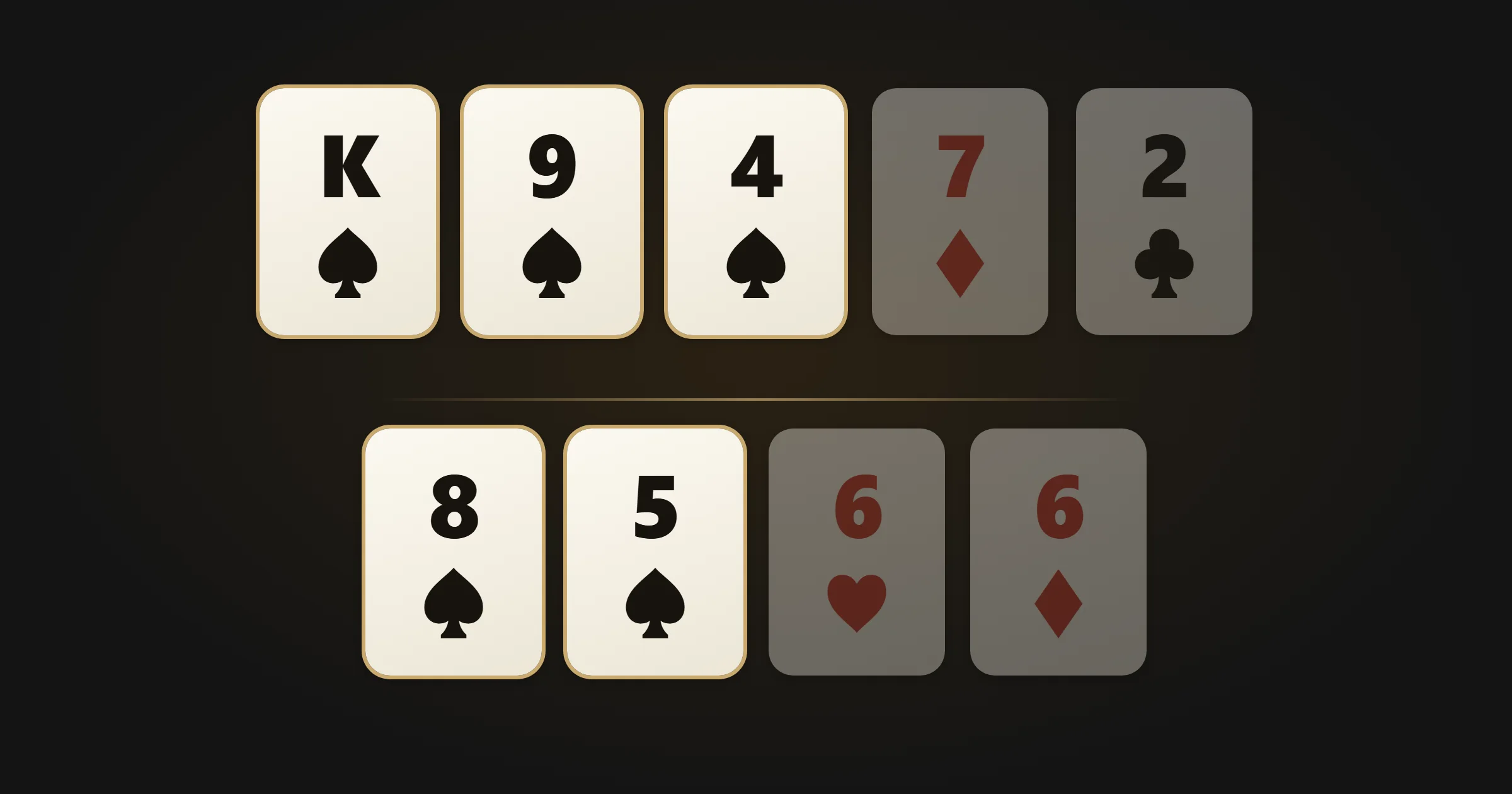
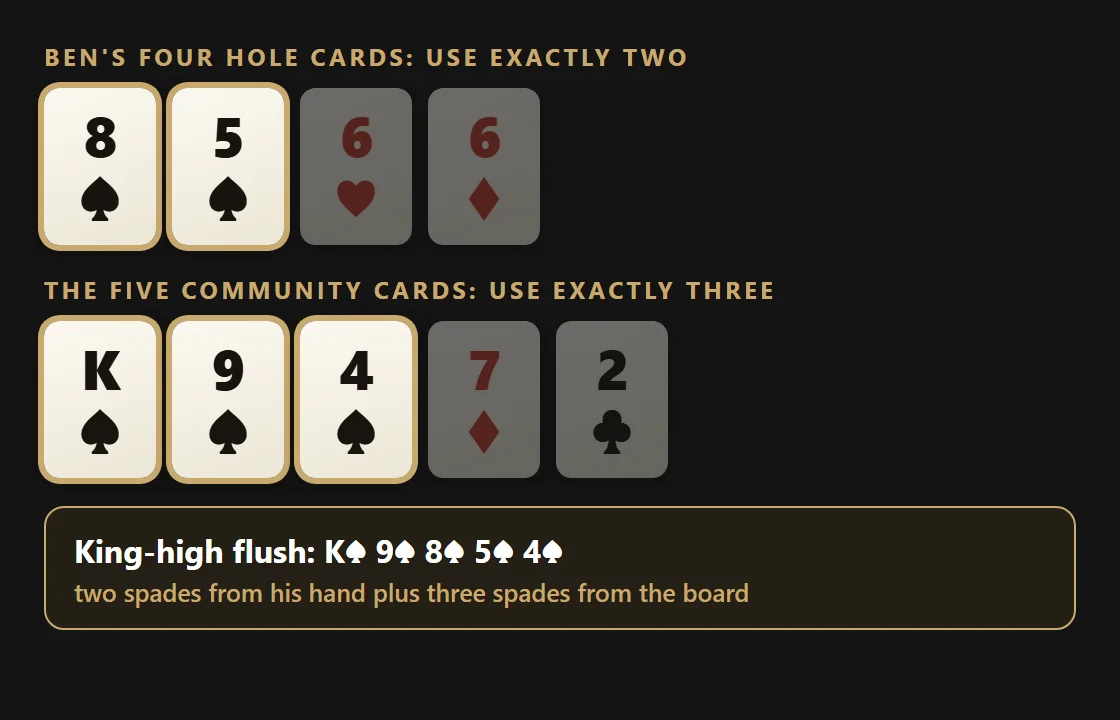
The board is K♠ 9♠ 4♠ 7♦ 2♣. Ann holds A♠ Q♥ J♦ 3♣, and Ben holds 8♠ 5♠ 6♥ 6♦.
Three spades are on the board. Ann has only one spade, so she cannot make a flush. Even though the ace of spades and the three board spades add up to four spades, a flush needs two spades from her hand. Her best hand is ace high.
Ben holds two spades. He uses 8♠ 5♠ from his hand and K♠ 9♠ 4♠ from the board to make a king-high flush.
Example 2: a straight beats three of a kind
The board is 8♣ 7♦ 6♠ K♥ 2♣. Ann holds 9♦ 5♥ A♠ A♦, and Ben holds K♦ K♣ Q♠ J♦.
Ann uses 9♦ 5♥ with 8♣ 7♦ 6♠ to make a straight from five to nine. Ben uses K♦ K♣ with K♥ and two other community cards to make three kings. A straight beats three of a kind, so Ann wins.
Example 3: the board cannot play
The board is 9♥ 8♦ 7♣ 6♠ 5♥, which is a straight by itself. Ann holds A♥ A♦ K♣ Q♠, and Ben holds 10♥ J♠ 2♦ 2♣.
In Texas Hold'em a player can use the five community cards as a hand. In Omaha, Ann cannot, because she must use two cards from her hand. Her best hand is a pair of aces. Ben uses 10♥ J♠ with 9♥ 8♦ 7♣ to make a jack-high straight, so Ben wins.
Six ways to pair your four hole cards
Four hole cards form six different pairs, and the five community cards form ten different groups of three. That is why an Omaha hand has 60 possible five-card combinations. Take the hole cards A♠ K♠ Q♦ J♦. The six pairs are:
- A♠ K♠
- A♠ Q♦
- A♠ J♦
- K♠ Q♦
- K♠ J♦
- Q♦ J♦
You choose one of these pairs and one group of three from the board to make your best hand.
Pot-limit betting: how much can you bet?
In a pot-limit game you cannot bet any amount you like. The biggest bet or raise is the size of the pot. When you raise, you count your own call first: the pot after your call is the most you can raise.
Here is a worked example:
| Step | What happens | Pot |
|---|---|---|
| 1 | The pot is $100 before betting | $100 |
| 2 | An opponent bets $100 | $200 |
| 3 | You call $100 | $300 |
| 4 | You raise by the full pot, $300 | $600 |
In this example, you put in $400 in total: the $100 to call and a $300 raise.
To work out your biggest raise, follow three steps:
- Start with the pot as it stands.
- Add the bet you are facing, and add your own call of that bet.
- The total is the most you can raise. Your whole move is the call plus that raise.
Try it with the numbers above: $100 plus $100 plus $100 is $300, so you can raise $300 on top of your $100 call.
The smallest bet is the big blind, and a raise must be at least as large as the previous bet or raise. A call matches the previous bet, and a raise matches it and then increases it.
The same rule applies before the flop. In a $1/$2 game, the blinds put $3 in the pot. The first player to act can call $2, which makes the pot $5, and then raise by $5, so the player puts in $7 in total.
Omaha can also be played as no-limit or fixed-limit, though this is less common, and this guide covers pot-limit Omaha, which is abbreviated PLO.
Betting rounds and blinds
A hand has four betting rounds: preflop, flop, turn, and river. The small blind and the big blind are forced bets posted by the two players to the left of the dealer button.
A PLO hand from start to finish: an example
Here is one hand of $1/$2 pot-limit Omaha with three players. Ann is on the dealer button, Cara posts the $1 small blind, and Ben posts the $2 big blind. The cards are the ones from Example 1, so Ann holds A♠ Q♥ J♦ 3♣ and Ben holds 8♠ 5♠ 6♥ 6♦.
- Preflop. Ann acts first, because she is the player to the left of the big blind, which with three players is the button. The pot is $3. She calls $2, which makes the pot $5, and raises by $5, so she puts in $7 in total. Cara folds her small blind. Ben calls, so the pot is $15.
- Flop: K♠ 9♠ 4♠. Ben acts first, because Cara has folded and he is the first active player to the left of the button. He checks. Nobody has bet, so the biggest bet Ann can make is the pot, $15. She bets $15, and Ben calls. The pot is now $45.
- Turn: 7♦ and river: 2♣. Both players check on both streets.
- Showdown. Ben uses 8♠ 5♠ and K♠ 9♠ 4♠ to make a king-high flush. Ann has only ace high. Ben wins the $45 pot.
Showdown and hand rankings
At the showdown, the best five-card hand wins the pot. If two players have exactly equal hands, they split it. If every other player folds, the last player wins the pot without showing their cards.
Omaha uses the same hand rankings as Texas Hold'em, from the royal flush at the top to high card at the bottom. You can see all ten hands with examples in our poker hand rankings cheat sheet.
Omaha hi-lo (eight or better)
Omaha hi-lo is a different version of the game. The pot is split between the best high hand and the best qualifying low hand. A qualifying low is made of five cards of different ranks, all eight or lower. If no hand qualifies for the low half, the best high hand wins the whole pot. Pot-limit Omaha as described here is high only, so only the best high hand wins.
Common beginner mistakes
Most mistakes in PLO come from five misunderstandings.
- Using three hole cards, or only one. You must use exactly two.
- Playing the board. The five community cards cannot make your hand on their own.
- Counting on a flush with only one suited hole card. You need two cards of the suit in your hand.
- Forgetting the call when you work out the pot-limit maximum. The pot you raise includes the bet you must call first.
- Mixing up PLO with Omaha hi-lo. In PLO there is no low hand.
Test yourself
How many hole cards does each player get in Omaha? Four.
Can you play the board in Omaha? No. You must use exactly two hole cards and three community cards.
The pot is $50, and an opponent bets $50. What is the most you can raise? You call $50, which makes the pot $150, so you can raise $150, for $200 in total.
PLO FAQ
What does PLO stand for? Pot-limit Omaha.
How many players can sit at an Omaha table? Usually two to ten.
How many five-card hands can you make from four hole cards and five community cards? 60: six pairs of hole cards times ten groups of three community cards.
What does pot-limit mean? The biggest bet or raise is the size of the pot after you have called any bet.
Can you use all four hole cards, or only one? Neither. You must use exactly two hole cards.
Do the Hold'em hand rankings apply? Yes. Omaha uses the same hand rankings.
What happens if two players have the same hand? The pot is split.
New to the words used here? Our poker terms glossary explains them in one place.
Responsible gambling
Poker played for money is gambling. Only play with money you can afford to lose. Real-money online poker is legal only in some US states. It is regulated state by state, and the minimum gambling age is 21+ in many states and 18+ in others, depending on the state and the product. Check your state's gaming regulator before you play for money, and play only on sites licensed in your state.
If gambling stops being fun, call or text 1-800-MY-RESET (1-800-697-3738) or visit 1800myreset.org. The National Problem Gambling Helpline is free, confidential, and available 24/7. It provides support and referrals to local resources. In an emergency, call 911 or 988.
More guides are on the Blog page.