
Poker positions are the names of the seats at the table, counted from the dealer button and the blinds. Your seat determines when you act in every betting round, and its name tells you where you stand in that order. This guide shows the names at a nine-handed table and at a six-max table, then walks through one hand step by step.
At a glance: poker positions
Here are the key points in seven bullets:
- The dealer button marks the dealer seat and moves one seat clockwise after every hand.
- With three or more players, the small blind sits to the left of the button, and the big blind sits to the left of the small blind.
- Before the flop, the player to the left of the big blind, called under the gun (UTG), acts first.
- After the flop, betting starts with the first player to the left of the button who is still in the hand, and the button acts last.
- Seats are named from the button: the cutoff is the seat to its right, and the hijack is the seat to the right of the cutoff.
- Position means your place in the betting order, and acting later gives you more information about what your opponents did.
- The names change with the table size and from one source to another.
What is position in poker?
Position in poker is your place in the betting order compared with the other players. After the flop, if you act after an opponent, you are in position against that opponent.
Why does it matter? A player who acts later has seen what the earlier players did before making a decision. Before the flop, a player under the gun has to decide without knowing how anyone else will act. That is the main idea behind position; the rest of this guide covers the seat names and the order of action.
The button and the blinds
The dealer button is a disc that shows which seat is the dealer for the current hand. After each hand it moves one seat clockwise, which is to the left. Because the button moves, every seat gets a new name each hand.
The two forced bets are tied to the button:
- The small blind sits directly to the left of the button.
- The big blind sits directly to the left of the small blind.
- Both blinds are posted before the cards are dealt.
Seats to the right of the button are named by counting back from it. The cutoff is the seat immediately to the right of the button. The hijack is the seat immediately to the right of the cutoff, two seats to the right of the button. The lojack is the next seat to the right of the hijack, three seats to the right of the button.
Poker positions at a nine-handed table
At a nine-handed table, nine seats are named. Counting clockwise from the button, you meet the two blinds first. After them come three UTG seats, then the lojack, the hijack, and the cutoff. Before the flop, the action runs from UTG around to the big blind.
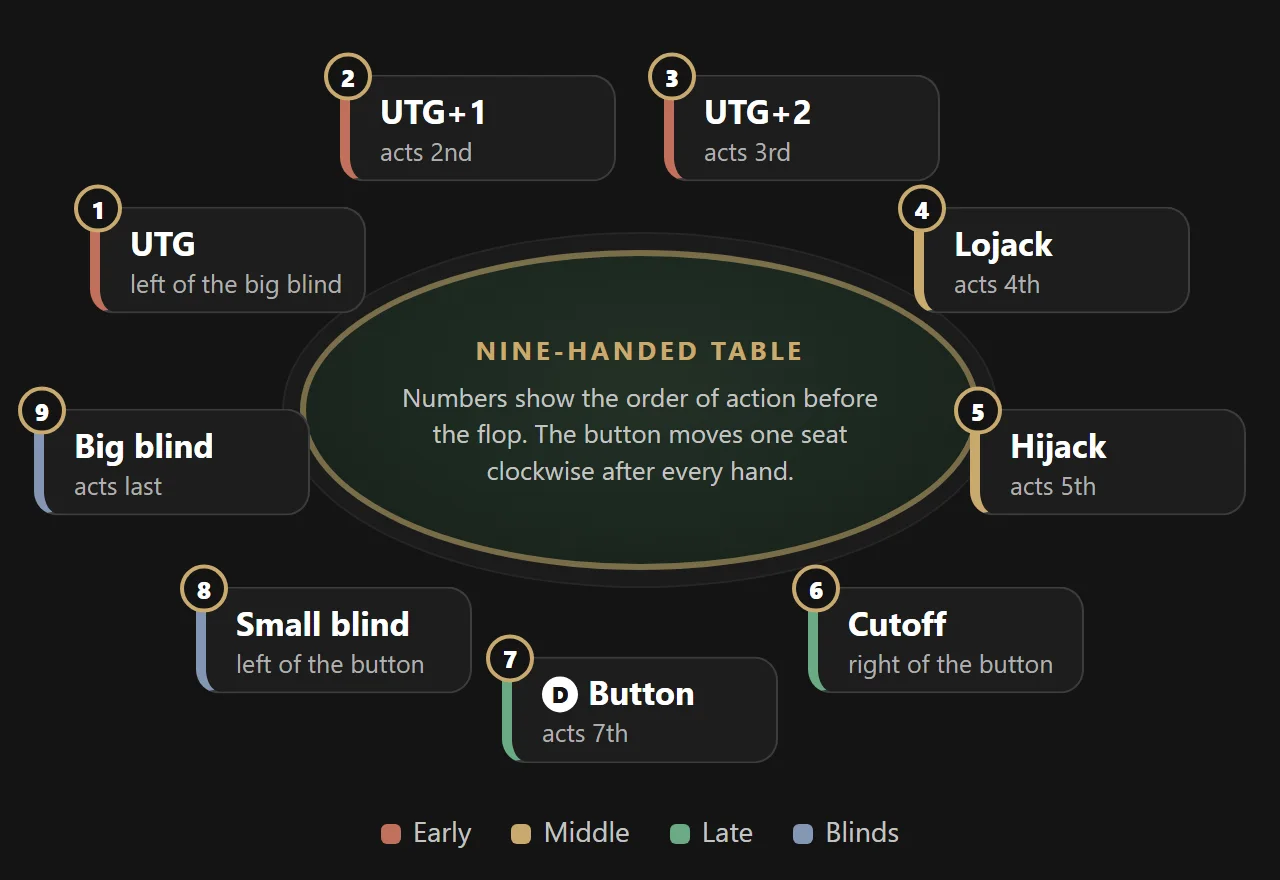
| No. | Name | Acts (before the flop) | Common group |
|---|---|---|---|
| 1 | UTG, left of the big blind | first | early |
| 2 | UTG+1 | second | early |
| 3 | UTG+2 | third | early |
| 4 | Lojack | fourth | middle |
| 5 | Hijack | fifth | middle |
| 6 | Cutoff, right of the button | sixth | late |
| 7 | Button | seventh | late |
| 8 | Small blind | eighth | blinds |
| 9 | Big blind | ninth, last | blinds |
Early position means the seats that act first before the flop. Late position commonly means the cutoff and the button, and middle position is what lies between. The groups in the table are one common way to split a nine-handed table. Which seats count as early, middle, or late depends on the table size.
Poker positions at a six-max table
A six-max table seats up to six players, so some of the nine-handed seat names disappear. Counting clockwise from the button, you meet the two blinds first. After them come UTG, the hijack, and the cutoff.
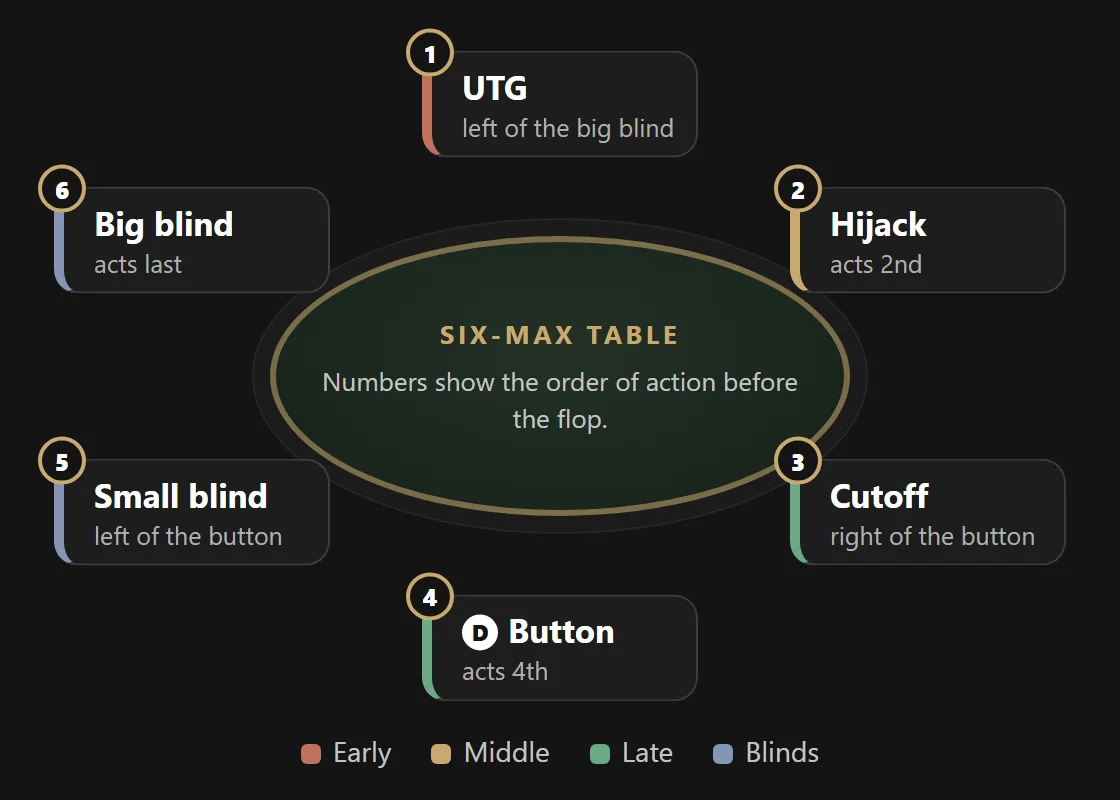
| No. | Name | Acts (before the flop) | Common group |
|---|---|---|---|
| 1 | UTG, left of the big blind | first | early |
| 2 | Hijack | second | middle |
| 3 | Cutoff, right of the button | third | late |
| 4 | Button | fourth | late |
| 5 | Small blind | fifth | blinds |
| 6 | Big blind | sixth, last | blinds |
Not every source uses these names. Position names vary between sources and with the table size, and one source calls the first seat to act at a six-max table the lojack. If a chart looks different from this one, count the seats from the button and compare the order, not the label.
Who acts first, and who acts last
The order of action changes after the flop, and this is a common mix-up for beginners. The rules below are for tables with three or more players.
- Before the flop: the player to the left of the big blind, UTG, acts first, and play continues clockwise. The big blind acts last.
- After the flop, turn, and river: betting starts with the first player to the left of the button who is still in the hand. The button acts last in each of these rounds, if still in the hand.
If the small blind is still in the hand after the flop, the small blind acts first, because that seat is directly to the left of the button. If the small blind has folded, the big blind acts first, and so on around the table.
A worked example: one hand at a nine-handed table
Nine players sit at the table. Ann has the button. Going clockwise from her, the seats are:
| Player | Seat in hand 1 |
|---|---|
| Ann | Button |
| Ben | Small blind |
| Cara | Big blind |
| Dan | UTG |
| Eli | UTG+1 |
| Fay | UTG+2 |
| Gus | Lojack |
| Hal | Hijack |
| Ivy | Cutoff |
Before the flop. Dan acts first, because he sits to the left of the big blind. Then Eli, Fay, Gus, Hal, Ivy, and Ann act in that order, followed by Ben. Cara acts last. Suppose everyone folds except Hal, Ann, and Cara.
After the flop. Betting starts with the first player to the left of the button who is still in the hand. Ben has folded, so Cara acts first. Hal acts second, and Ann acts last, because she is on the button.
So after the flop, Ann is in position against both Hal and Cara, and Hal is in position against Cara.
The next hand. The button moves one seat clockwise, to Ben. Every seat gets a new name:
| Player | Seat in hand 2 |
|---|---|
| Ben | Button |
| Cara | Small blind |
| Dan | Big blind |
| Eli | UTG |
| Fay | UTG+1 |
| Gus | UTG+2 |
| Hal | Lojack |
| Ivy | Hijack |
| Ann | Cutoff |
Ann was on the button, and now she sits immediately to the right of the new button, so she is the cutoff. Ivy, the old cutoff, has become the hijack. Nobody changed seats; the names moved around the table.
Heads-up and Omaha
With only two players, called heads-up, the player on the button posts the small blind and the opponent posts the big blind. The order-of-action rules in this guide are written for tables of three or more players.
Omaha uses the same dealer button, blinds, and four betting rounds as Texas Hold'em. The button, the blinds, and under the gun work the same way there: under the gun is the seat to the left of the big blind in both games. For the Omaha rules themselves, see our pot-limit Omaha guide.
Common beginner mix-ups
- Thinking the button never moves. It moves one seat clockwise after every hand, so the seat names rotate.
- Counting the cutoff to the left. The cutoff is to the right of the button. The seat to the left of the button is the small blind.
- Thinking the blinds act first before the flop. At a nine-handed table they act last before the flop, with UTG acting first.
- Expecting the same order before and after the flop. The first player to act changes from UTG to the first player to the left of the button who is still in the hand.
- Assuming every chart uses the same names. Names such as lojack and UTG+1 differ between sources and with the table size.
Test yourself
At a nine-handed table, who acts first before the flop? The player under the gun, to the left of the big blind.
Who acts last after the flop? The player on the button, if still in the hand.
Where is the cutoff? Immediately to the right of the button.
You are the cutoff this hand. Which position do you have on the next hand? The hijack, because the button moves one seat clockwise and you are then two seats to its right.
Poker positions FAQ
What are the different positions in poker? Most seats are named by their distance from the dealer button. The names include the two blinds, under the gun, the lojack, the hijack, and the cutoff.
What does UTG mean in poker? Under the gun, the seat to the left of the big blind. That player acts first before the flop.
What is the cutoff in poker? The seat immediately to the right of the dealer button.
What is the hijack in poker? The seat immediately to the right of the cutoff.
What is early, middle, and late position? Early position acts first before the flop, late position commonly means the cutoff and the button, and middle position lies between them. The exact seats depend on the table size.
What is the hardest position to play in poker? This guide explains only the order of action, not strategy. What we can say is this: the player under the gun acts first before the flop and must decide without knowing what anyone else will do. The blinds are the first seats to act after the flop.
Do the positions change in Omaha? No. The button, the blinds, and under the gun work the same way in Omaha.
New to poker words? Our poker terms glossary explains the common ones in one place, and the guide on how to play poker covers the full hand. Once you know the seats, the poker hand rankings cheat sheet shows what beats what.
Responsible gambling
Poker played for money is gambling. Only play with money you can afford to lose. Real-money online poker is legal only in some US states. It is regulated state by state, and the minimum gambling age is 21+ in many states and 18+ in others, depending on the state and the product. Check your state's gaming regulator before you play for money, and play only on sites licensed in your state.
If gambling stops being fun, call or text 1-800-MY-RESET (1-800-697-3738) or visit 1800myreset.org. The National Problem Gambling Helpline is free, confidential, and available 24/7. It provides support and referrals to local resources. In an emergency, call 911 or 988.
More guides are on the Blog page.